
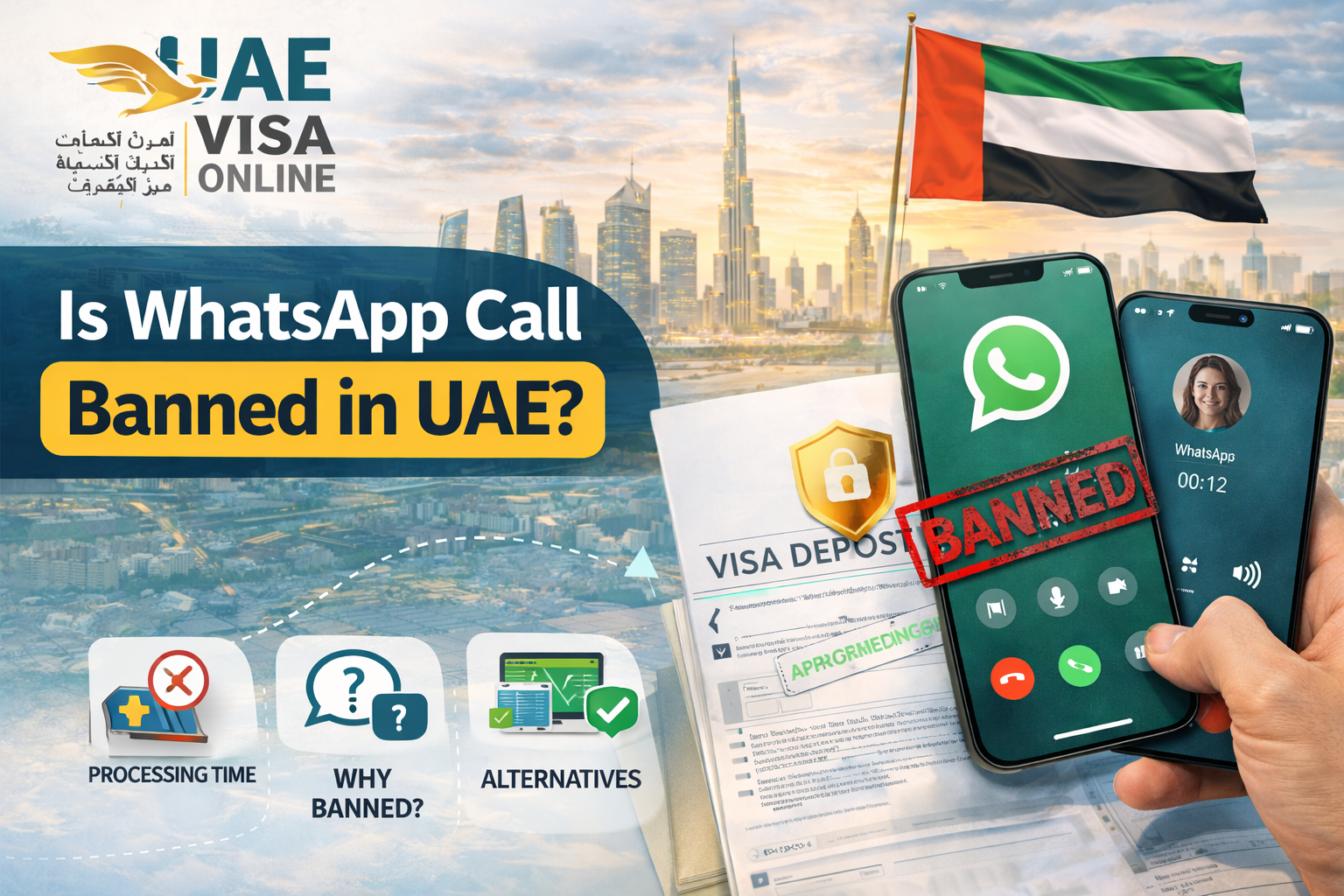
You land in Dubai, open WhatsApp to call your family — and nothing happens. Call failed. No connection. No warning.This is the reality for every tourist and resident in UAE in 2026. The WhatsApp call ban in UAE has been in place for years — yet most travelers find out only after they land. No airline tells you. No hotel warns you. Your visa approval email mentions nothing about it.
Whether you are an Indian tourist whose UAE VoIP restriction just hit you at the airport, a business traveler needing reliable communication, or a UAE resident looking for the fastest legal fix — this complete guide tells you exactly why WhatsApp calling is blocked, which apps work legally, what the VPN fine actually is, and how to stay connected from minute one of your arrival.
Traveling to UAE? Apply through UAE Visa Online — our experts guide you on approved communication apps, tourist SIM setup, and everything before you land.
Are WhatsApp Voice and Video Calls Still Restricted in Dubai 2026
Yes — WhatsApp calling blocked in UAE applies across all seven emirates in 2026 Dubai, Abu Dhabi, Sharjah, Ajman, RAK, Fujairah, and Umm Al Quwain. No tourist exemption exists.
What works and what does not:
| Feature | Status in UAE 2026 |
|---|---|
| WhatsApp text messages | Works normally |
| WhatsApp photos and videos | Works normally |
| WhatsApp voice notes | Works normally |
| WhatsApp voice calls | Blocked |
| WhatsApp video calls | Blocked |
| WhatsApp group calls | Blocked |
| FaceTime | Blocked |
| Skype calls | Blocked |
Do restrictions apply to tourists? Yes — the UAE internet call restriction applies equally to tourists, residents, and business travelers without exception.
Why UAE Blocks WhatsApp Calling — Real Reasons Behind the Ban
WhatsApp Calling Prohibited Under UAE Telecom Law — Here Is Why
WhatsApp calls use VoIP (Voice over Internet Protocol) — calls travel over internet instead of mobile network. In UAE, VoIP is strictly regulated by TDRA (Telecommunications and Digital Government Regulatory Authority). Only apps officially partnered with licensed telecom operators — Etisalat (e&) and du — can offer internet calling legally. WhatsApp has not entered such agreements — so calling remains disabled.
Three Core Reasons UAE Blocked WhatsApp Calls
1. Telecom revenue and licensing UAE telecom providers invest heavily in infrastructure. Free VoIP calls impact their revenue — licensed apps ensure financial sustainability and service accountability.
2. Encryption and security monitoring WhatsApp calls are end-to-end encrypted — government authorities cannot monitor call content. This creates law enforcement challenges — a key reason the UAE blocked WhatsApp calls initially and has maintained the restriction.
3. Quality control and accountability Licensed apps operate under strict TDRA service standards — unlicensed apps have no accountability for data privacy or call reliability in UAE.
Which Officially Licensed Apps Allow Voice Calls in Dubai Legally
The most practical question — which approved calling apps do UAE residents use instead of WhatsApp?
| App | Type | Cost | Provider |
|---|---|---|---|
| BOTIM | Voice + Video | ~AED 50/month | Etisalat + du |
| C'Me | Voice + Video | Paid | du |
| HiU Messenger | Voice + Video | Free with du plan | du |
| Voico | Voice | Free with Etisalat | Etisalat |
| Zoom | Video conferencing | Free + Paid | Both |
| Microsoft Teams | Business calls | Free + Paid | Both |
Why Is BOTIM the Most Popular Legal Calling App in UAE
BOTIM was the first app to officially partner with both Etisalat and du — making it the default WhatsApp replacement for UAE residents and tourists. Clear voice quality, video calling, group calls, and a simple AED 50/month subscription make it the most reliable option.
BOTIM setup in 3 steps:
- Download BOTIM from App Store or Play Store — do this before you travel
- Purchase UAE tourist SIM at airport — Etisalat or du counter
- Activate VoIP add-on plan — AED 50/month — register and call instantly
Can Indian Tourists Use Their WhatsApp Account for Calling in Dubai
Texting yes — calling no.
Indian tourists can use existing WhatsApp for text messages, photos, and voice notes without issues. But WhatsApp voice call disabled the moment you try to call — whether on Indian SIM, UAE SIM, or WiFi.
How Indian Tourists Can Stay Connected in Dubai
- Keep WhatsApp for texting — works perfectly
- Download BOTIM before departure from India
- Buy tourist SIM at Dubai airport — Etisalat or du
- Activate VoIP plan — AED 50/month
- Inform family to download BOTIM before you travel
Set up BOTIM in India before landing — saves scrambling at Dubai airport on arrival.
If your UAE visa gets rejected before travel — read our guide on UAE visa rejected — how to fix and reapply in 24 hours before booking flights.
Is It Legal to Use VPN for WhatsApp Calls in UAE — Real Fine Amount
Can UAE Authorities Detect and Track VPN Usage
Yes. TDRA actively monitors network traffic patterns. Detecting individual users is difficult — but using VPN specifically to bypass UAE telecom restrictions is illegal under UAE Cybercrime Law.
What Is the Fine for Using Unauthorized VoIP Apps in UAE
| Violation | Fine |
|---|---|
| Using VPN for banned services | Up to AED 2,000,000 |
| Using unlicensed VoIP app | Up to AED 2,000,000 |
| SIM misuse | Suspension + fine |
Risks of using VPN for WhatsApp calls:
- Legal fines up to AED 2 million
- SIM card suspension
- Unstable unreliable connections
- Potential travel ban implications for residents
Always check UAE visa ban countries list before travel — any existing immigration issue combined with VPN violation can cause serious complications.
Rule: VPN for general browsing = gray area. VPN to bypass UAE telecom ban = illegal — not worth the risk.
Latest 2026 Update on WhatsApp Calling Restrictions in UAE
Is There Any Update on UAE Allowing WhatsApp Calls in 2026
As of March 2026 — no official announcement from TDRA or UAE government regarding lifting the WhatsApp call ban in UAE. Restriction remains fully in effect.
UAE has progressively liberalized digital policies — Zoom and Microsoft Teams approved for business, more apps expected in coming years. WhatsApp calling approval remains possible but has not happened yet.
Source: TDRA official portal (tdra.gov.ae) ; March 2026 guidelines
Best Legal Alternatives to WhatsApp Calling for Tourists in Dubai
| Need | Best App | Cost |
|---|---|---|
| Personal calls | BOTIM | AED 50/month |
| Family video calls | BOTIM / C'Me | AED 50/month |
| Business meetings | Zoom / Teams | Free tier |
| Group calls | BOTIM | Included |
| Cheap international calls | Voico | Free with Etisalat |
After your UAE visa is approved — verify your UAE visa file number and ensure your Emirates ID biometrics are scheduled before departure.
Common Questions About WhatsApp Calling in UAE
Can I FaceTime in Dubai
No — FaceTime uses VoIP and is blocked under the same UAE internet call restriction as WhatsApp. Use Zoom or Microsoft Teams for video calls — both officially approved.
Why Is My BOTIM Call Not Working
- VoIP add-on not activated — contact Etisalat or du
- WiFi blocking VoIP — switch to mobile data
- App needs update — check App Store
How to Make WhatsApp Calls Work in UAE Legally Without VPN
Simple — switch to BOTIM for calls, keep WhatsApp for messaging. No VPN needed, no legal risk, reliable connection guaranteed.
Conclusion
The WhatsApp call ban in UAE is not going away anytime soon in 2026. But staying connected is completely easy once you know the right apps and setup process.
Download BOTIM before you travel. Get UAE tourist SIM at airport. Activate VoIP plan. Keep WhatsApp for texting — it works perfectly. And avoid VPNs — a 2 million dirham fine is not worth a free call.
Note: All information based on UAE telecom regulations as of March 2026. Verify latest updates on tdra.gov.ae before travel.
Need UAE visa before your trip? Apply through UAE Visa Online — fast processing, expert support, and complete pre-travel communication guidance.