

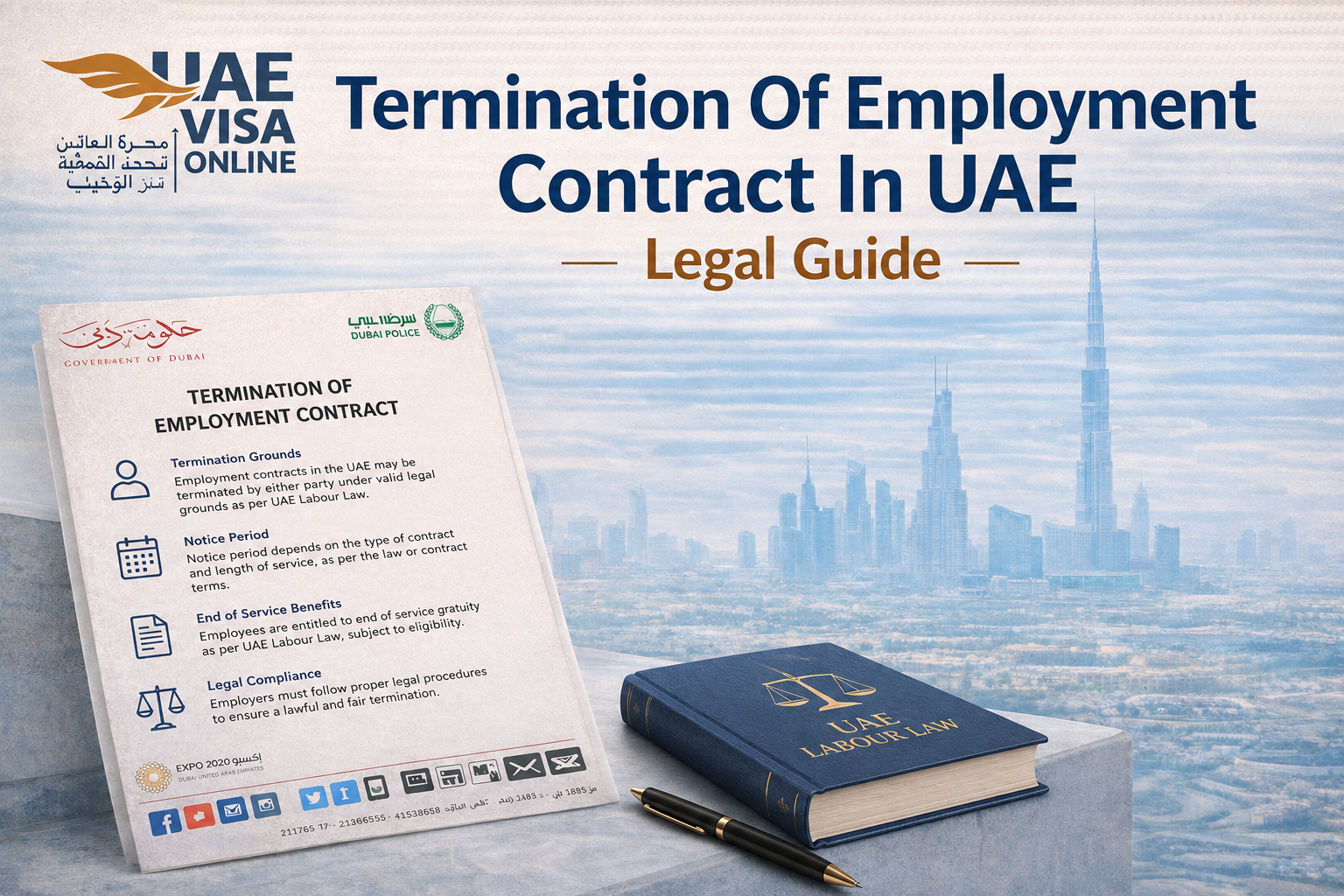
The termination of an employment contract in the UAE is one of the most significant legal events an employee or employer can face in the private sector. Whether you have been dismissed from your job unexpectedly or your employer has given you formal notice, knowing your rights under UAE Federal Decree-Law No. 33 of 2021 (the New Labour Law, effective February 2022) is essential before you take any step.
This complete guide covers everything — from legal grounds and notice periods to end-of-service gratuity, final settlement, visa grace periods, and whether you can immediately join a new company. Before taking any action, we recommend you check your UAE labour contract online to understand the terms already binding you.
Note: Federal Decree-Law No. 33 of 2021 applies to all private sector employees across the UAE, except those working in DIFC (Dubai International Financial Centre) and ADGM (Abu Dhabi Global Market), which operate under their own separate employment regulations
What the New UAE Labour Law Says About Termination of Employment Contract
The 2022 Labour Law brought sweeping changes to how employment contract termination in UAE is handled. It replaced the older 1980 law and introduced stronger protections for both workers and employers. The law covers all private sector workers across all seven Emirates, regardless of nationality.
Under UAE Labour Law, there are two types of employment contracts — and the termination of employment contract rules differ between them:
Limited (Fixed-Term) Contract: Has a defined end date. If either party ends it early without valid cause, the other party may claim compensation equivalent to the remaining contract period's wages.
Unlimited Contract: Has no set end date. Either party may end the employment relationship for any legitimate reason, provided the mandatory 30–90 day written notice is served.
All new contracts signed after February 2, 2022 must be fixed-term under the new Labour Law. Unlimited contracts signed before this date remain valid until they are renewed or amended.
Legal Grounds for Termination in UAE
Under the new law, a lawful termination of employment contract in UAE can happen under the following circumstances:
Lawful vs. Unlawful Grounds for Employment Termination
| Legal vs. Unlawful Grounds for Termination | |
|---|---|
| Legal Grounds for Termination | Unlawful / Arbitrary Grounds |
| Mutual written agreement | Termination based on gender, race, or religion |
| End of fixed-term contract | Dismissal for filing a legal complaint |
| Gross misconduct (Article 44) | Termination during maternity leave |
| Business restructuring / redundancy | Termination without notice or compensation |
| Employee's consistent poor performance (documented) | Arbitrary dismissal with no valid reason |
| Medical incapacity (certified) | Retaliation-based dismissal |
| Permanent closure of the establishment per UAE legislation | - |
| Employer’s bankruptcy, insolvency, or exceptional economic reason | - |
| Employee fails to renew work permit for reasons beyond employer’s control | - |
Source: UAE Ministry of Human Resources & Emiratisation – Federal Decree-Law No. 33 of 2021
Can an Employer Terminate Without Reason?
Under UAE labour law, if a company terminates an employee without a justified reason, it is treated as arbitrary dismissal. The employee is entitled to compensation of up to three months' full salary (basic + allowances) in addition to all other end-of-service dues. Employers must ensure documented grounds exist before proceeding with any job dismissal in the UAE.
Notice Period Requirements for Termination of Employment
Minimum Notice Period in UAE Labour Law
One of the most searched questions is "how many days notice for termination of employment" in the UAE. Under the new Labour Law, the notice period depends on the length of service:
UAE Notice Period Guidelines Under Article 43
| UAE Notice Period Rules — Article 43 | |
|---|---|
| Rule | Detail |
| Minimum notice period | 30 days |
| Maximum notice period | 90 days |
| Who sets the exact duration | Your employment contract defines the exact notice days within this 30–90 day range |
| Who it applies to | Both employer and employee equally |
| During notice period | Employee continues working and receives full salary |
| If employer terminates | Employee gets 1 unpaid day off per week to search for a new job (employee chooses the day and must inform employer 3 days in advance) |
| If notice is not served | The party who fails to serve must pay salary in lieu of notice as compensation |
During the notice period, the employee must continue working and receiving full pay. Neither party can waive this period unilaterally.
Can an Employer Terminate Without Reason ?
Yes — but only by mutual written agreement. If both the employer and employee agree in writing to waive the notice period, the employer must pay the equivalent salary in lieu of notice. This means the employee receives the full salary they would have earned during the notice period as a lump-sum payment. Refusing to pay salary in lieu of notice is a violation of UAE Labour Law and can be reported to the Ministry of Human Resources and Emiratisation (MOHRE).
Important — MOHRE Reporting Rule: Under Article 44, if an employer terminates an employee for gross misconduct (such as deliberate property damage), the employer must report the incident to MOHRE within 7 working days from the date of discovering the misconduct. Failure to report within this window can make the dismissal legally invalid.
Under Article 47 of UAE Labour Law, an employer cannot terminate a worker because they filed a complaint with MOHRE, raised a labour dispute, or exercised any legal right guaranteed under the law. Doing so constitutes arbitrary dismissal and entitles the employee to compensation of up to 3 months' full salary in addition to all other end-of-service dues.
"Additionally, the notice period must always be equal for both parties — an employer cannot set a longer notice period for the employee than they themselves would serve, unless it is specifically in favour of the worker."
What Happens to You After Termination of Employment in UAE
UAE Grace Period After Job Loss
A very commonly asked question is "how long can I stay in the UAE after termination of employment." Once your employment is officially ended and your work permit is cancelled, you are legally entitled to a 60-day grace period to either secure a new job or make arrangements to leave the country. This grace period is provided automatically and you do not need to apply separately for it.
During this window, you remain in the UAE legally. However, your employer must formally cancel your work visa through MOHRE and the General Directorate of Residency and Foreigners Affairs (GDRFA). It is important to understand whether an immigration ban in the UAE has been placed on your file before making travel decisions.
The employer must complete two separate cancellation steps
-
Cancel the work permit through MOHRE
-
Cancel the residency visa through GDRFA (General Directorate of Residency and Foreigners Affairs)
The 60-day grace period begins only after both cancellations are processed. Make sure you receive written confirmation of both to track your legal stay timeline accurately.
What Happens If You Overstay After Termination
If you do not find a new job or leave the UAE within the 60-day grace period, you will begin to accumulate overstay fines of AED 50 per day after the first day, plus an AED 200 administrative fee. Prolonged overstay can result in a deportation order and a future UAE visa ban. Workers who fear fines should also check if they qualify under any visa amnesty programme for workers in UAE, which the government periodically announces for undocumented residents.
Benefits of a Terminated Employee in UAE
Gratuity Calculation in UAE
End-of-service gratuity is one of the most important UAE Labour Law termination benefits. Every employee who has completed at least one year of continuous service is entitled to gratuity upon termination of work contract, regardless of whether they resigned or were dismissed (except in cases of gross misconduct under Article 44).
End-of-Service Gratuity Calculation Explained
| End-of-Service Gratuity Calculation | |
|---|---|
| Years of Completed Service | Gratuity Entitlement |
| Less than 1 year | No gratuity |
| 1 to 5 years | 21 calendar days' basic salary per year |
| More than 5 years | 30 calendar days' basic salary per year (for years beyond 5) |
| Maximum cap | Total gratuity cannot exceed 2 years' total salary |
Sample End-of-Service Gratuity Calculation
| Example Gratuity Calculation | ||
|---|---|---|
| Period | Calculation | Amount (AED) |
| First 5 years | 21 days × 5 years = 105 days ÷ 30 × AED 10,000 | 35,000 |
| Year 6 (beyond 5 years) | 30 days × 1 year ÷ 30 × AED 10,000 | 10,000 |
| Total Gratuity | 45,000 | |
Note: Gratuity is calculated on basic salary only, excluding allowances such as housing or transport.
Add this note after the example:
UAE National Employees: If you are a UAE national who was registered for employment after October 31, 2023, your end-of-service benefit is not calculated as gratuity. It is instead administered through the national pension and social security system under Federal Decree No. 57 of 2023. Verify your entitlement directly with your HR department.
Prices and thresholds above are based on UAE Federal Decree-Law No. 33 of 2021. Government policy is subject to change. Always verify with MOHRE's official gratuity calculator.
Final Settlement and Pending Salary
The compensation for termination of employment UAE law requires employers to settle all dues within 14 days of the termination date. Your final settlement must include:
-
All pending and unpaid salary up to the last working day
-
Salary in lieu of notice (if applicable)
-
Encashment of unused annual leave days
-
End-of-service gratuity as calculated above
-
Any other contractual benefits owed
Failure to pay within 14 days entitles the employee to file a complaint with MOHRE and claim additional compensation. UAE domestic workers also have specific protections — learn more in our guide on UAE domestic workers' rights.
Can You Join Another Company After Termination in UAE?
Transfer Rules After Termination
Can I join another company after termination in the UAE? Yes — this is fully allowed under the new Labour Law. One of the biggest reforms in UAE Federal Decree-Law No. 33 of 2021 is the removal of employment bans for most private sector workers. Previously, employees could face a 6-month or 1-year ban from working in the UAE after certain types of employment separation. This restriction has been largely abolished.
1-Year Work Ban Still Applies In Two Cases: Under Article 8 of Ministerial Resolution No. 47 of 2022, an employee cannot obtain a new work permit for 1 year from their departure date if:
-
They terminated the contract themselves during probation and the employer did not breach any obligation
-
A "work abandonment" report filed against them by the employer was proven true
If either applies to you, check for any UAE immigration ban on your file before attempting to join a new company.
Do You Need NOC to Change Jobs?
Under the new law, a No Objection Certificate (NOC) from the previous employer is no longer mandatory for most employees to transfer to a new company. However, employees on unlimited contracts that were signed before February 2022 should review their contract terms carefully. If you are unsure about your contract type, check your UAE labour contract online before signing with a new employer.
Non-Compete Clause After Termination
When you sign a termination of work contract in UAE, some employment agreements include a non-compete clause that restricts you from joining a competing company immediately after leaving. Under UAE Labour Law, these clauses are legally enforceable only if they meet all three conditions:
Understanding UAE Non-Compete Clause Legal Limits
| UAE Non-Compete Clause — Legal Limits | |
|---|---|
| Condition | Legal Limit |
| Duration | Maximum 6 to 12 months after termination |
| Geographic Scope | Limited to one emirate or a clearly defined area |
| Scope of Work | Must relate only to your specific role — not the entire industry |
If your non-compete clause exceeds these limits, it may be challenged legally. Consult a UAE labour lawyer if you believe your clause is unreasonably broad.
Disclaimer
The information provided in this article is for general informational and educational purposes only and does not constitute legal advice. UAE labour laws and related regulations are subject to updates and amendments by the government. While we have made every effort to ensure accuracy based on UAE Federal Decree-Law No. 33 of 2021 and MOHRE guidelines, readers are strongly advised to consult a qualified UAE labour lawyer or visit the official MOHRE website or UAE Government Portalfor the most current and case-specific guidance. Gratuity amounts, notice periods, and visa grace periods referenced in this article reflect the law as of 2025 and may change.
For more helpful guides on UAE residency and immigration, explore our resources on UAE visa ban countries and UAE immigration ban.