

Your family belongs with you, not thousands of miles away waiting for paperwork to clear. Yet every week, UAE residents put off their family visa application because they are unsure where to start, what salary they need, or which documents will be accepted. That hesitation can mean weeks or months of avoidable separation.
The rules are more generous than many residents realise. Sponsors can bring in a spouse and children on a minimum salary of AED 4,000, or AED 3,000 plus accommodation, and no profession restriction has applied since 2022. The process itself is manageable, but it does not forgive small mistakes. One missing document, one unattested certificate, or a salary certificate that doesn't match your bank statements can send you back to square one, and you lose time and fees.
This guide covers eligibility, salary thresholds, documents, fees, timelines, rejection risks and renewals, so you can apply correctly the first time. Before you start, check your family member's nationality against the UAE visa ban countries list.
UAE Family Visa at a Glance
| Item | Details (2026) |
|---|---|
| Minimum salary: spouse and children | AED 4,000/month, or AED 3,000 + employer-provided accommodation |
| Minimum salary: parents | Commonly AED 20,000/month; Dubai GDRFA also lists a lower-threshold route (see below) |
| Sons | Unmarried, up to 25 years (with conditions) |
| Daughters | Unmarried, any age |
| Medical fitness test | Required for applicants aged 18+ |
| Health insurance | Mandatory in Dubai and Abu Dhabi; check rules in other emirates |
| Typical timeline | About 10–15 working days |
| Typical all-in cost | AED 2,000–4,500 per dependent |
Who Can Sponsor a Family in the UAE?
Any UAE resident with a valid residence visa who meets the income and accommodation rules can apply. In practice that includes:
- Employees with a valid work residence visa and an attested salary certificate or contract
- Business owners and partners with a valid trade licence
- Freelancers with a valid permit and proof of income
- Golden Visa holders, who have no minimum salary requirement
- Green Visa holders, who can also sponsor family members under approved terms
Visit visa holders, and people without valid UAE residency, cannot sponsor anyone. You also need an Emirates ID and a tenancy contract in your name (or an employer accommodation letter) that suits the size of your family.
Who Can You Sponsor?
Spouse. Your legally married partner. You need a marriage certificate attested through the proper chain, which usually means the home-country authorities, the UAE embassy and the UAE Ministry of Foreign Affairs (MOFA).
Sons. Boys can be sponsored up to age 25. If they are over 20, you must submit a non-married certificate from your home country's consulate in the UAE. Older guides say 18, which is out of date.
Daughters. Unmarried daughters can be sponsored indefinitely, with no age limit. Married children cannot be sponsored.
Children with special needs. They can be sponsored regardless of age, with additional supporting documents.
Stepchildren and adopted children. These are possible with proper legal documentation, such as court papers or custody proof.
Parents. Possible at a much higher income threshold, with proof of accommodation, health insurance and often a security deposit. Details are in the salary section below. For age-specific documents when sponsoring minors, see the UAE child visa policy.
What Is the Minimum Salary for a UAE Family Visa?
Salary is the most common reason applications fail, so verify this first.
| Who you sponsor | Typical requirement |
|---|---|
| Spouse and children | AED 4,000/month, or AED 3,000 + accommodation provided by the employer |
| Parents | AED 20,000/month (some sources cite AED 19,000 with a 2-bedroom home) |
| Parents (Dubai GDRFA humanitarian/parent route) | AED 10,000/month, with extra conditions |
| Golden Visa holders | No minimum salary |
A few points to be aware of:
Accommodation must be documented. A housing allowance alone does not qualify you for the lower AED 3,000 threshold. Your employer must formally certify that housing is provided.
Combined income can help in some cases. GDRFA Dubai has a route for sponsoring children where the couple's combined salary is under AED 4,000, backed by both spouses' documents. For parents, some guides say a wife's salary can be added to the husband's to reach the threshold. Confirm this with the authority handling your case.
Female sponsors may face a higher bar. Some sources report that women sponsoring a husband and children need AED 10,000 a month. Thresholds and conditions have varied in practice, so check the current requirement with ICP or GDRFA before applying.
Parent sponsorship varies by emirate. Dubai has a standard AED 20,000 route and a humanitarian route at AED 10,000 through Amer centres. A 2-bedroom residence is required to sponsor parents. Expect proof of dependency and higher health insurance costs for older parents.
Salary proof must match. Your contract, salary certificate, bank statements and payroll (WPS) records should all tell the same story. Salary is proven through the employment contract, salary certificate and bank statements.
Documents Required for a UAE Family Visa
Requirements shift slightly by emirate and relationship, but you should prepare the following:
Sponsor documents
- Valid UAE residence visa copy
- Passport copy
- Emirates ID copy
- Salary certificate or employment contract (attested where required)
- Latest three months of bank statements
- Tenancy contract (Ejari in Dubai, or the registered equivalent elsewhere) or an employer accommodation letter
- Trade licence and partnership documents, if you are a business owner
Family member documents
- Passport copy with at least six months' validity
- Recent passport-size photo on a white background
- Attested marriage certificate (spouse) or birth certificate (children). Certificates must be fully attested by MOFA.
- Non-married certificate for sons over 20 and for daughters, where requested
- Valid health insurance policy, where mandatory
- Medical fitness test result (adults 18+), completed during the process
Keep every scan clear and complete. Blurry or cropped uploads are a routine cause of delays. If any document isn't in Arabic or English, budget for a certified translation.
How to Apply for a UAE Family Visa Online
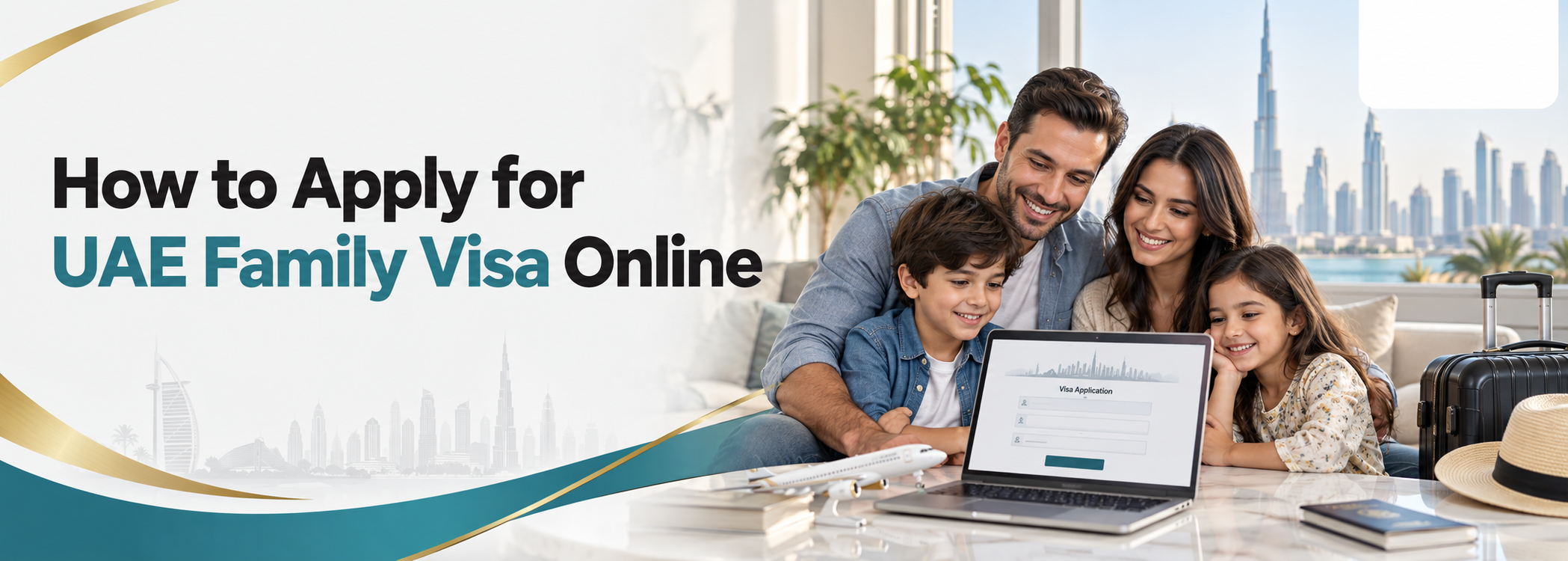
The application is handled by ICP and GDRFA in Dubai. You can submit through official smart channels, an approved typing centre, or an authorised visa service provider like UAE Visa Online, which lets you upload documents, pay and track progress without visiting a government office.
The steps depend on whether your family member is inside or outside the UAE.
Step 1: Create or Update Your Sponsor File
First-time sponsors usually need a sponsor file set up through an approved service channel. Make sure your salary, accommodation and residence details are correct before submitting anything.
Step 2: Apply for the Entry Permit (or Status Change)
- Family member outside the UAE: you apply for an entry permit. Once it's approved, typically within a few working days, they travel to the UAE on it.
- Family member already inside on a visit visa: you apply for an in-country entry permit and a change of status. This avoids leaving the country, but costs more (see fees below). Complete it before the visit visa expires, or you risk fines. See our guide on overstaying rules in UAE.
Step 3: Medical Fitness Test
Family members over 18 need an approved medical fitness test as part of the residence process. Children under 18 are generally exempt, which saves a meaningful amount per child. Results usually take one to three working days, depending on the centre and whether you choose fast-track.
Step 4: Emirates ID Registration
The family member completes biometric registration at an authorised typing centre or ICA service centre, and the Emirates ID application is linked to the residence file. Processing typically takes three to five working days. Abu Dhabi residents can check the Abu Dhabi Emirates ID biometrics centre locations to find the nearest centre.
Step 5: Residence Visa Issuance
Once the medical result and Emirates ID application are in, the residence visa is issued. Depending on the emirate and channel, this is either stamped in the passport or delivered as a digital e-visa linked to the Emirates ID. When it is done, your family member is legally resident under your sponsorship.
Applying for a Family Visa in Dubai
Dubai sponsors can run the whole process online through an authorised provider or through GDRFA channels. Upload your documents, pay the fees and follow the status in real time. Expect to visit a medical centre and an Emirates ID centre, since biometrics and the medical test can't be done remotely.
How Much Does a UAE Family Visa Cost in 2026?
The total is a stack of separate fees, and the biggest swing factor is whether your family member applies from outside or inside the UAE. All-in cost, including insurance, typically lands between AED 2,000 and AED 4,500 per dependent.
| Fee component | Indicative range (AED) |
|---|---|
| Entry permit (applicant outside UAE) | ~340–600 |
| Entry permit (applicant inside UAE) | ~990–1,150 |
| Change of status (inside UAE only) | ~630–700 |
| Medical fitness test (18+) | ~270–500 (fast-track up to ~700) |
| Emirates ID | ~100 per year of validity + ~100 service fee |
| Residence visa issuance/stamping | ~400–600 |
| Health insurance (annual) | ~600–1,200 basic; more for parents |
| Typing centre/service charges | Varies by provider |
Inside vs outside. One provider's breakdown shows an outside-UAE adult costing roughly AED 1,376 in government fees against about AED 2,656 inside, because of the higher entry permit and the change-of-status charge. Treat these as indicative, since fees differ by emirate, channel and year.
1-year vs 2-year visas. The visa stamping fee does not change with visa length, but the Emirates ID cost rises with validity. A one-year ID is about AED 200, a two-year ID about AED 300, and a three-year ID about AED 400. Insurance is renewed annually either way. A longer visa usually means fewer renewals and less admin, so it is often better value if your own visa allows it.
Children. They skip the medical test, so the total is lower than an adult's.
Hidden costs. Attestation of marriage and birth certificates, certified translations and insurance are often left out of quoted totals. Ask for an itemised estimate before you commit.
Fees change, so confirm current rates with ICP or GDRFA before paying.
How Long Does Processing Take?
A well-prepared application now typically takes around 10 to 15 working days. Here is a realistic breakdown:
| Stage | Estimated time |
|---|---|
| Entry permit approval | 2–5 working days |
| Medical fitness test | 1–3 working days |
| Emirates ID registration | 3–5 working days |
| Visa issuance | 1–3 working days |
| Total end-to-end | About 10–15 working days (7 days in the best case) |
Can it be done in two days? Not realistically. Several stages run independently, and each has its own processing time. Express services can speed up the entry permit stage, and fast-track medical centres return results in hours, but Emirates ID and issuance still take their normal time.
Attestation of overseas documents is often what slows people down. Start it before you apply.
Why UAE Family Visa Applications Get Rejected
Yes, family visas can be rejected, and it happens more often than most sponsors expect. The common reasons are:
- Salary below the threshold. AED 4,000 (or AED 3,000 + certified accommodation) for spouse and children, and the higher figure for parents.
- Unattested or invalid relationship documents. Marriage and birth certificates must go through the full attestation chain.
- Poor-quality uploads. Blurry, cropped or incomplete scans are refused.
- Expired or short-validity passport. Six months of validity is the safe minimum.
- Missing health insurance. Mandatory in Dubai and Abu Dhabi, and often required elsewhere.
- Immigration violations. Overstay history, fines or a ban on the family member's record. If you suspect a problem, check the UAE immigration ban status first.
- Mismatched salary evidence. A salary certificate that doesn't match bank statements raises flags.
- Failed medical test. Screening covers tuberculosis, HIV, hepatitis B and C and certain other communicable diseases. A positive result leads to visa refusal, and the person must leave the UAE.
How to avoid rejection
- Verify your salary and accommodation against the exact rule before applying
- Attest all relationship documents through official channels
- Arrange health insurance before submitting
- Use an authorised provider to check documents in advance
- Apply well before any visit visa expires
How Long Is a UAE Family Visa Valid?
Validity depends on the sponsor's own visa type, and a family visa can't outlast the sponsor's residence visa. Family visas are commonly issued for one, two or three years, depending on the sponsor's visa and the emirate. Parents are typically granted a one-year residency that must be renewed annually. Golden Visa holders can sponsor family for much longer periods.
Is it temporary or permanent? It is a renewable residence visa, not a permanent one. You renew it through the same channels, usually with an updated medical test, Emirates ID and insurance, before it expires.
What if your job changes? If your employment visa is cancelled or expires, your family's status is affected too. A grace period generally applies after cancellation, but the length depends on the type of residence, so confirm with ICP right away and avoid overstay fines. For workers in transition, see the UAE visas amnesty for workers guide.
Apply for Your UAE Family Visa Today
Your family shouldn't wait any longer than necessary. You now know the requirements, costs, timeline and rejection risks, and the only step left is to start.
Do not risk rejection with incomplete documents or missed steps. Apply through UAE Visa Online, where professional experts handle every stage of your application, from entry permit to residence visa, fast, securely and online.