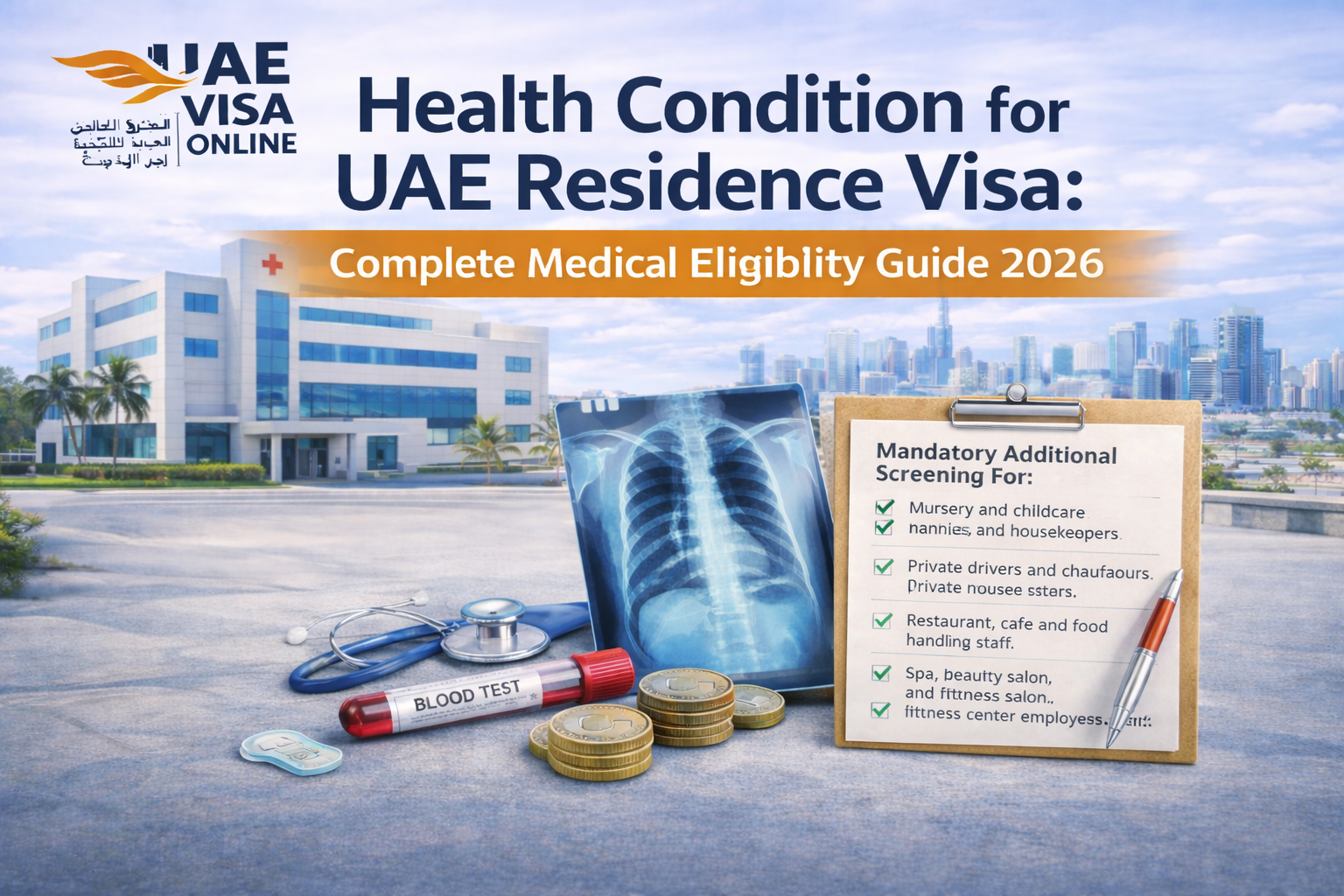
Planning your move to the UAE? Understanding the
health condition for UAE residence visa requirements is the most critical step before submitting your application. The UAE maintains strict
medical fitness exam standards that every applicant must clear—regardless of whether you're applying for work, family sponsorship, or business residency. This comprehensive 2026 guide covers everything from disqualifying diseases to chronic condition policies, ensuring you know exactly where you stand before investing time and money in your visa process.
The most searched concerns tell the real story. Syphilis UAE visa rules, hepatitis B UAE visa eligibility, and the list of deportable diseases in UAE catch thousands of applicants completely off guard every year — at the final stage of their application.
Whether you are asking — can I get a UAE visa if I have Hepatitis B — worried about — is syphilis banned in UAE — or trying to understand — what medical conditions can cause visa denial — this guide answers everything clearly before you apply.
Why Health Screening is Mandatory for UAE Residence Visa
The health condition for UAE residence visa assessment isn't optional—it's federal law. The UAE government requires all new residents to undergo medical examination to protect public health and maintain workforce productivity. The Dubai Health Authority (DHA) and Ministry of Health and Prevention (MOHAP) enforce these standards across all Emirates.
Your medical fitness certificate directly determines whether your residence visa gets stamped or rejected. Unlike tourist visas, residency permits demand proof that you pose no public health risk. This screening applies equally to employment visa holders, family visa dependents, domestic workers, and investors. Understanding these requirements early prevents costly application failures and potential deportation risks.
If you're concerned about eligibility before starting the process, verify your basic visa requirements through our
UAE visa number and UID number guide to ensure your documentation is correctly linked in the immigration system.
Diseases That Disqualify You From UAE Residence Visa
The UAE maintains absolute clarity about which health condition for UAE residence visa applications result in automatic rejection. Three infectious diseases trigger mandatory visa denial under Federal Law: HIV/AIDS, active pulmonary Tuberculosis, and active Syphilis.
Infectious Diseases (Automatic Rejection)
| Disease | Test Method | Result Consequence | Reapplication Possible? |
|---|
| HIV/AIDS | Blood antibody test | Immediate rejection; deportation if discovered during renewal | No |
| Active Tuberculosis | Chest X-ray + sputum analysis | Rejection; mandatory treatment before reconsideration | Yes, after certified cure |
| Active Syphilis | Blood VDRL/RPR test | Immediate rejection; deportation for residents | No |
| Hepatitis B (specific roles) | HBsAg blood test | Rejection for food handlers, childcare, healthcare workers | Role-dependent |
HIV/AIDS carries zero tolerance—no exceptions exist for any visa category. Active TB differs slightly: applicants can reapply after completing documented treatment and presenting a fitness certificate from a UAE-approved facility. Syphilis follows the same strict protocol as HIV—active infection means permanent visa ineligibility.
For
Hepatitis B, the
health condition for UAE residence visa rules vary by profession. General office workers may receive case-by-case assessment, while
food handlers, nannies, and salon workers face automatic rejection due to transmission risk through blood contact. Understanding these distinctions before applying saves months of processing delays.
Critical Distinction: Hepatitis B Carrier vs. Active Infection
Not all Hepatitis B diagnoses are equal. Carriers (HBsAg positive but low viral load) sometimes secure visas for non-sensitive roles. Active infections (high viral load, elevated liver enzymes) face rejection across all categories. The UAE medical exam specifically tests HBsAg, but employer discretion plays a role in final approval—particularly for white-collar positions.
Chronic Health Conditions & UAE Visa Eligibility
Here's where confusion often occurs. The
health condition for UAE residence visa screening primarily targets
infectious diseases—not chronic non-communicable conditions. Thousands of residents live and work in the UAE with diabetes, hypertension, asthma, and heart disease.
Conditions That Do NOT Disqualify You
| Condition | Screening Detail | Visa Impact | Documentation Needed |
|---|
| Diabetes | Random Blood Sugar + HbA1c tested | None—results recorded only | Home country medical report (optional) |
| Hypertension | Blood pressure check during physical | None—routine monitoring | None |
| Asthma | Spirometry for some categories | None—assessment only | Inhaler prescription (carry personally) |
| Heart Disease | ECG for applicants over 40 or specific roles | None if stable | Cardiologist report recommended |
| Mental Health | No formal psychiatric screening | None—depression/anxiety not tested | None required |
Diabetes mellitus and UAE residence visa approval 2026—applicants frequently worry about this. The truth? Your blood sugar levels are recorded, but diabetes itself never causes rejection. The UAE wants data for public health tracking, not exclusion. Similarly, psychological wellness screening for UAE visa 2026 doesn't exist in standard protocols. Depression, anxiety, and managed mental health conditions don't appear on medical fitness reports.
However, if you take controlled medications, bring prescriptions and ideally a translated medical report from your home country doctor. While not mandatory, this documentation prevents customs complications when carrying personal medication supplies.
For applicants with complex medical histories, our guide on
what to do after UAE visa rejection provides contingency planning strategies—even though chronic conditions rarely trigger rejection.
Special Category Workers: Stricter Health Standards
Certain professions face enhanced health condition for UAE residence visa requirements beyond standard screening. If you work (or plan to work) in these sectors, prepare for additional tests:
Mandatory Additional Screening For:
-
Nursery and childcare workers
-
Domestic servants, nannies, housekeepers
-
Private drivers and chauffeurs
-
Restaurant, café, and food handling staff
-
Spa, beauty salon, and fitness center employees
These roles require negative Hepatitis B and Syphilis results—no exceptions. Stool sample testing for intestinal parasites also applies to food handlers and domestic workers. The rationale? Direct contact with vulnerable populations (children, elderly) or consumable products demands higher infection control.
Can Hep B carriers in hospitality sector get UAE visa 2026? For food-related roles, the answer is definitively no. For childcare or eldercare, equally strict. These policies reflect WHO guidelines on bloodborne pathogen transmission in high-contact professions. If you're Hepatitis B positive, consider role negotiation with your employer before visa application—shifting to administrative positions may preserve eligibility.
Pre-Application Health Screening Strategy
Should you get tested before applying? Yes—strategically. While the official health condition for UAE residence visa exam happens inside the UAE, pre-screening in your home country identifies potential issues early.
Pre-Application Testing Recommendations
| Scenario | Recommended Action | Timeline Before Travel |
|---|
| Prior TB exposure | Chest X-ray and specialist letter | 3 months |
| Hepatitis B carrier status | Viral load test and liver function | 2 months |
| History of syphilis (treated) | Documentation of cure from licensed physician | 3 months |
| Chronic conditions | Translated medical report with medication list | 1 month |
| Pregnancy | Obstetric confirmation and due date | Immediate |
Can Indians complete UAE visa health screening before travel 2026? Certain Indian medical centers are pre-approved for Gulf Cooperation Council (GCC) visa medicals—particularly for construction, hospitality, and domestic worker visas. These screenings accelerate UAE arrival processing but don't replace the mandatory in-country DHA/MOHAP verification. Confirm your employer's specific requirements, as policies vary by visa sponsor.
Similarly, Pakistan applicants UAE visa health requirements 2026 include designated panel physicians in Karachi, Lahore, and Islamabad. These pre-screenings reduce arrival delays but don't guarantee final approval—UAE authorities retest upon entry.
For all applicants, understanding how to verify your UAE visa authenticity before travel prevents falling victim to fraudulent medical clearance schemes.
Medical Rejection: Appeals & Next Steps
If your health condition for UAE residence visa assessment returns "unfit," options depend on the specific finding:
Active TB diagnosis: Complete 6-month treatment, obtain cure certificate from UAE-approved facility, reapply. This is the only "reversible" rejection.
HIV/AIDS or active Syphilis: No appeal pathway exists. These results are final.
Disputed results: Challenging UAE immigration health refusal 2026 requires submitting contradictory evidence from a licensed specialist within 30 days. Success rates are low unless laboratory error is proven.
Reapplication timeline: After rejection, you may reapply after 6 months for most conditions. However, infectious disease findings are flagged permanently in immigration databases—subsequent applications face heightened scrutiny.
Before reapplying, check whether your nationality faces additional restrictions through our
UAE visa ban countries guide—medical and administrative rejections sometimes overlap.
The Costs of Residence in UAE
Dh.25 for children aged 0 to 9.
Dh.50 for children aged 10 to 17 years.
Over the age of 18 – Dh.100
(For expatriates)
Dh.100 for children aged 0 to 9.
Dh.200 for children aged 10 to 17 years.
Over the age of 17 – Dh.300
(in addition to the Dh.200 for the medical exam)
Final Checklist: Health Condition for UAE Residence Visa Success
Before submitting your application:
-
[ ] Screen for HIV, TB, Hepatitis B, Syphilis in home country (optional but recommended)
-
[ ] Obtain translated medical reports for chronic conditions
-
[ ] Confirm role-specific requirements if in food/childcare/healthcare sectors
-
[ ] Verify pregnancy status and Emirates-specific policies
-
[ ] Check child visa policies if applying with family
Understanding your health condition for UAE residence visa standing before application prevents costly rejections and deportation risks. The UAE's medical fitness system is strict but transparent—know the rules, prepare documentation, and proceed with confidence.
Conclusion
The foundation of the residency application will determine the specific examinations the citizen will need. The examinations can alter significantly depending on if you're seeking domestic work, an office job, or just as the wife of a UAE resident. They usually test for hepatitis, syphilis, tuberculosis, and HIV. The medical examination will occur after you visit the UAE on a residential entrance permit and before the residency visa is issued. When you attend a typing centre with your UAE Entrance Visa to enrol for the medical exam, the sort of tests you will be required to undertake will be determined automatically in the UAE immigration system. When you arrive at the test lab, the physician will understand precisely what tests to do according to your medical history.
Key Takeaway: Infectious diseases like HIV/AIDS, active TB, and syphilis block approval—while diabetes, hypertension, and mental health conditions pass standard screening.
Ready to secure your UAE residence visa?
Apply Now at UAE Visa Online — Fast processing, expert medical guidance, and 24/7 support for your journey to the Emirates.